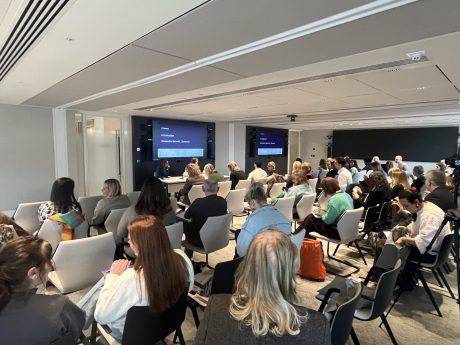
On 29 January, Stewarts held its first conference aimed at supporting families through early years special educational needs (SEN) and education, health and care plans (EHCP). The group heard from experts who offered advice and guidance in navigating SEN support and EHCPs for children who sustained brain injuries at birth.
Alexandra Bennett, a legal director in our Medical Negligence department specialising in birth injuries, hosted the conference and introduced the speakers. Alexandra opened by stating that everyone in the room knows that every child has individual needs and that to enable them to access education, progress, enjoy their education and reach their potential, it’s essential to ensure they have the right support in the right educational environment.
The purpose of the conference was to provide practical guidance to help parents and professionals who support a child with special educational needs to achieve the right educational setting during the crucial early years of a child’s life.
Rehabilitation after hypoxic neonatal injury: what families need to know
Dr Ruth Kent, Consultant in Neurological Rehabilitation, kicked off our expert sessions with a presentation covering transition, outcomes and rehabilitation needs for childhood brain injury survivors.
Hypoxic‑ischaemic injury at birth affects around 2–3 in every 1,000 babies and can lead to a wide range of developmental outcomes. Early assessment and intervention are crucial. Clinicians begin with neurological examinations, brainwave monitoring and MRI scans, which help guide treatment and long‑term planning. Therapeutic hypothermia (cooling therapy delivered within the first six hours of life) significantly reduces the risk of disability, but many children still require ongoing support as they grow.
Dr Kent explained that outcomes vary widely, from full recovery to challenges with movement, learning, communication and behaviour. Some effects become more noticeable when a child reaches school age, highlighting the need for long‑term follow‑up. Early intervention takes advantage of the brain’s neuroplasticity, with integrated therapy during the first five years shown to have the greatest impact. A multidisciplinary team may include paediatricians, physiotherapists, occupational therapists, speech and language therapists, psychologists, specialist teachers and dietitians. Parents are central partners throughout.
Therapy focuses not only on motor development but also on communication, feeding, sensory processing, sleep, behaviour and emotional regulation. Specialist equipment, seating, mobility aids and adapted learning approaches play a key role in supporting children’s independence and participation in daily life. As children transition into education, strong collaboration between health and education teams ensures continuity of care, often supported by EHCPs.
Key takeaways
- Early intervention is vital to improve long‑term outcomes
- Rehabilitation should be holistic, involving health, education and family support
- Social participation is as important as physical progress
- Long‑term monitoring is essential, as some challenges emerge later in childhood or adolescence.
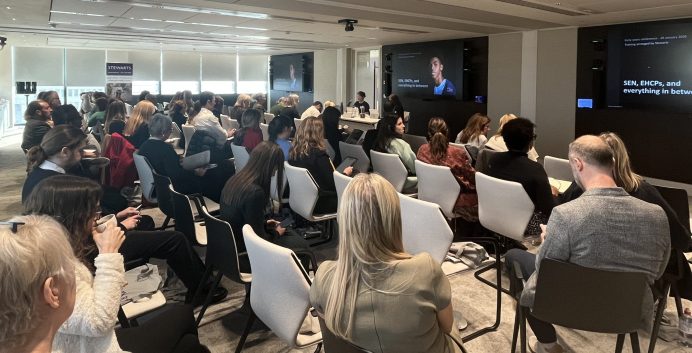
Neuropsychology and neurodevelopment in children with early brain injuries
Next up, Consultant Paediatric Neuropsychologist Dr Angela Simcox explored how early brain injuries affect a child’s cognitive, emotional and developmental trajectory, and the crucial role neuropsychology plays in specialist educational planning.
Dr Simcox began by outlining the distinct contribution of neuropsychologists: understanding the relationship between brain development and behaviour, interpreting complex learning profiles, and identifying strengths and vulnerabilities that may not be visible through standard educational assessments. Early brain injuries often disrupt multiple neural circuits, leading to uneven cognitive profiles and long‑term difficulties with processing speed, attention, executive functioning, working memory and visuospatial or motor integration.
She highlighted that developmental challenges may not appear immediately but can emerge “downstream” as a child grows and demands increase. Fatigue, reduced cognitive stamina and emotional regulation difficulties are common, underscoring the need for ongoing assessment rather than one‑off evaluations.
Crucially, neuropsychological assessment provides the foundation for robust SEN planning. Dr Simcox demonstrated how detailed formulation links brain‑based vulnerabilities to classroom presentation, enabling tailored strategies such as one-to-one support, structured breaks, targeted cognitive interventions, environmental adjustments and therapeutic input from speech and language or occupational therapy. These insights are essential for developing high‑quality EHCPs, Education Otherwise Than At School (EOTAS) packages or alternative provision.
Key takeaways
- Early brain injuries affect multiple developmental domains and may evolve over time
- Neuropsychological assessment provides depth beyond attainment scores, revealing hidden needs
- Executive functioning, attention and cognitive stamina are particularly vulnerable
- EHCPs should be grounded in clear, evidence‑based neuropsychological recommendations
- Multidisciplinary collaboration is essential to achieving long‑term, strengths‑based outcomes
Making EHCPs work for children and young people with brain injury
The next presentation was from educational specialist Emily Neal from Encompass Now. Emily explored how EHCPs can be made truly effective for children and young people with acquired or congenital brain injuries. These children often have complex, fluctuating needs, and ensuring their support is implemented correctly can be the difference between exclusion and meaningful progress.
Emily emphasised the importance of translating multidisciplinary assessments, including therapeutic, clinical and educational input into one coherent, practical plan. Her role involves identifying needs, ensuring therapy recommendations are written clearly into Section F of an ECHP, training staff and monitoring provision across mainstream, special schools and EOTAS packages.
The presentation highlighted how vague EHCP wording such as “support as needed” leaves children vulnerable. Through case studies, Emily demonstrated how unclear provision results in unmet needs, behavioural misinterpretation and placement breakdowns. Conversely, specific, quantified support, such as structured rest breaks, sensory strategies, named adult check‑ins and clearly timetabled therapy, can immediately improve engagement, emotional regulation and learning.
Emily also addressed scenarios across mainstream, specialist and alternative provision, showing that therapy must always be explicitly written into the EHCP regardless of setting. For some children who cannot cope in school environments, EOTAS or alternative provision must be carefully designed, monitored and integrated.
Key takeaways
- EHCPs must be specific, measurable, enforceable and needs‑led
- Section F should clearly translate Section B EHCP needs into actionable provision
- Vague wording leads to missed support; quantified provision ensures delivery
- Therapy must be explicitly written into the plan, regardless of setting
- Effective EHCPs require monitoring, collaboration and regular review
Understanding SEN and EHCPs in the early years
Identifying and supporting SEN in the early years is essential to giving children the best possible start. In our next session, Jennifer Wright from Rook Irwin Sweeney covered how early years providers, health professionals and parents all play a vital role in recognising developmental concerns and responding quickly. The SEND Code of Practice emphasises that early action is critical, as timely support can significantly improve long‑term outcomes.
Jennifer explained how children may need support in one or more areas, including communication and interaction, cognition and learning, social, emotional and mental health, or sensory and physical development. When concerns arise, nurseries and early years settings must follow a graduated approach, assessing needs, planning support, taking action and reviewing progress. This SEN support is delivered from within the setting’s own resources and must be developed in partnership with parents.
Where a child’s needs are more complex or progress is limited, families or settings may request an Education, Health and Care (EHC) needs assessment. Local authorities must consider an assessment where a child may have SEN and may require provision beyond what a mainstream setting can offer. If issued, an EHCP sets out the child’s needs, the support required and the educational placement and is legally enforceable.
Regular reviews, every three to six months for under‑fives, ensure the EHCP remains appropriate as the child develops. Parents also have rights to challenge decisions through mediation or appeal.
Key takeaways
- Early identification and prompt intervention are essential
- SEN support should be personalised, reviewed regularly and developed with parents
- EHCPs secure legally enforceable, long‑term support where needed
- Understanding the system helps families advocate effectively
Advocating for the right provision: supporting every child’s needs
Our final presentation of the day was from Launa Randles, Headteacher at The Children’s Trust. Every child deserves the right provision to thrive, and effective advocacy ensures their needs are understood, respected and met. Launa highlighted why the correct educational, health and care support is essential, particularly for children with complex needs.
Central to effective advocacy is the principle of “See Like Me”, understanding each child as an individual and recognising the lived experiences of their family. Parent testimonials illustrate how the right school placement can transform not only a child’s progress but the wellbeing of the entire family. When provision aligns with a child’s needs, children are happier, healthier and more engaged in learning.
Launa said that a key part of the process is the EHCP, which legally integrates the support a child needs. EHCPs focus on needs, not labels, ensuring children can access learning meaningfully. The presentation outlines each stage of the EHCP journey, from initial concerns and SEN support through to assessment, drafting and issuing the final plan. It emphasises the importance of clear, evidence‑based descriptions of a child’s strengths and needs, as these directly affect the quality and enforceability of the support provided.
Launa was adamant that the child’s voice, expressed however they communicate, must always be represented. Families are encouraged to share their insights, seek advice and work collaboratively with schools and local authorities.
Key takeaways
- The right provision transforms outcomes for children and families
- EHCPs should clearly reflect a child’s needs, strengths and required support
- Advocacy is about clarity, evidence and persistence, not conflict
- The child’s voice is essential, regardless of communication method
- Families and professionals must work in partnership to secure the right provision
Conclusion
The conference provided a forum for parents, carers and healthcare professionals who support children during the critical early years of development to come together and share knowledge and best practice on how to advocate for their needs and put them at the centre of any plan.
Conference attendee, Penny Harger, relationship officer from the charity Peeps HIE, commented:
“The conference helps highlight some of the long-term implications associated with having a child with a brain injury, including the importance of early years support to help families access education and ensure that they know their rights about the EHCP processes and other legalities surrounding SEND.
It’s hard to find further support and for families to know where to access it if they need to. There are so many different support and services available.
Hypoxic-Ischaemic Encephalopathy(HIE) families are already managing lots of different issues, including their healthcare needs as well as appointments, work schedules, other caring responsibilities and trying to maintain their family’s health needs at the same time. In addition, there is extra stress of trying to find the education that is right for their child, and there are so many different options available to them. There are special schools, there might be special units within mainstream schools, mainstream schools, or there may be an option for their child to be educated other than at school.
“Peeps helps support these families in lots of different ways. We have our peer support service, our ‘let’s chat’ sessions and our closed social media groups. We also refer families to other services, charities and organisations, as needed. We encourage anyone who needs support to get in touch.”
Anita Jewitt, Head of Medical Negligence at Stewarts, commented:
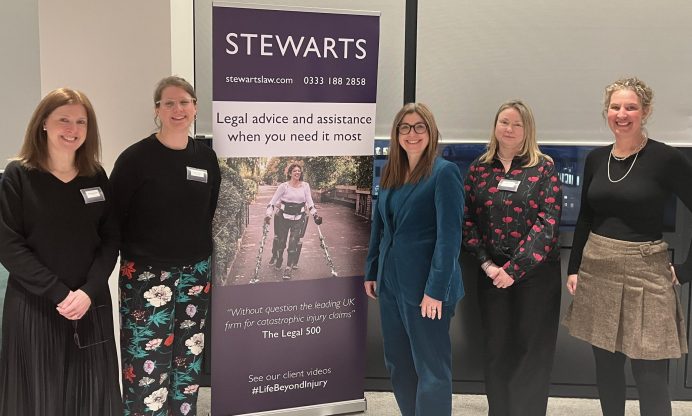
“We were joined in our offices by almost 100 parents and healthcare professionals who heard from a panel of expert speakers on how best to navigate the complex education system and how best to support a child who has sustained a brain injury at birth.
“We see first-hand through supporting our clients at Stewarts, the complex and lengthy process families go through to best support a child who has sustained a life-changing brain injury.
“I am grateful to everyone who attended and to all of our expert speakers for helping everyone walk away more informed and more reassured on how best to navigate this process.”