Scam emails, websites and other fraudulent communications
From time to time, clients and members of the public may receive communications that appear to come from Stewarts but are not genuine.
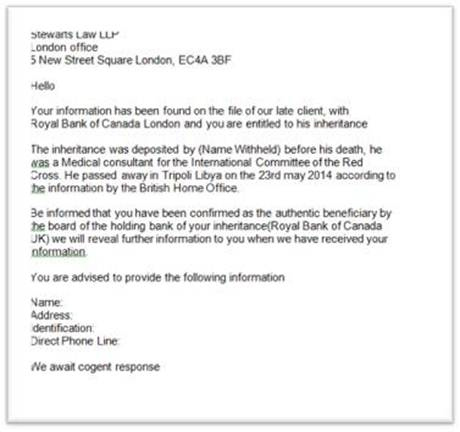
These communications may take the form of emails, letters, websites, social media messages or other correspondence that falsely use the Stewarts name, branding, or the names of our lawyers and employees. They may be designed to obtain money, personal information, banking details or other sensitive information.
In some cases, fraudsters may send communications that closely resemble genuine correspondence from Stewarts. They may claim that bank details have changed, request payment, seek personal information, or invite you to visit a website that appears to be connected to the firm or click another type of link. Sometimes the communication may appear to come from a third party, such as a government body or financial institution, while making reference to Stewarts.
Fraudulent websites and emails may contain malicious software designed to compromise your device or steal information. Please exercise caution before opening attachments, clicking links or responding to unexpected communications.
How to protect yourself
Please keep the following in mind:
- If you are unsure whether a communication is genuine, do not respond to it. Contact your usual Stewarts contact using independently verified contact details or contact the firm using the details published on this website
- We will not ask you to change payment details solely by email. Any request to change bank account details should always be verified directly with your usual Stewarts contact
- Unexpected requests relating to payments, personal information or bank details or inviting you to click unexpected links should be treated with caution
- Our official website domain is www.stewartslaw.com. Any variation should be treated with caution and independently verified
- You should ensure that appropriate security measures, including anti-virus and device security software, are kept up to date.
If you receive a suspicious communication
If you receive a communication that purports to be from Stewarts and you believe it may be fraudulent:
- Do not respond
- Do not click any links or open attachments
- Do not provide personal, financial or identity information
- Contact Stewarts using independently verified contact details to verify the authenticity of the communication
- Consider reporting the matter to the relevant authorities or fraud reporting services.
Liability
Stewarts encourages clients and members of the public to independently verify any request involving payments, bank account details or sensitive information. Taking these simple precautions can significantly reduce the risk of fraud and help ensure communications are genuine.
Reporting fraud and scams
- UK police – www.actionfraud.police.uk
- US authorities – reportphishing@apwg.org
Scam alerts
- Solicitors Regulation Authority – https://www.sra.org.uk/consumers/scam-alerts/
Examples of attempted scams using the Stewarts name:
- Emails in June 2026 claiming to be from Stuart Carson, Partner – using a non-Stewarts email address [stuartcarson36@gmail.com]. Unsolicited approach to member of the public informing them they have been named as a beneficiary to a deceased client’s Will and requesting personal data and identification documents. Warning to members of the public NOT TO SEND any personal data or documents onto the email stuartcarson36@gmail.com and always verify any requests. Stuart Carson, is a genuine solicitor and Partner at this firm but he did not send these emails, and he does not use or recognise the email address: stuartcarson36@gmail.com
- imessages/ Telegram in March 2026 claiming to be from Stewarts Law about “matters involving online fraud, misappropriation of digital assets, and unauthorised financial transactions” and inviting members of the public to make contact via Telegram handle @calista503 – this is not one associated with or linked to Stewarts Law and there is no one by the name Calista employed at this firm.
- Emails in March 2026 claiming to be from Sean Stewart Senior Solicitor – using a non-Stewarts email address and no one employed by this name at the firm
- Emails in June 2025 claiming to be from Stewarts’ Managing Partner John Cahill (who is in fact the firm’s former and not current Managing Partner) using a non-Stewarts email address, usually a gmail.com or sunoo.com email address
- Emails in early 2025 claiming to be from Stewarts’ Managing Partner John Cahill (who is in fact the firm’s former and not current Managing Partner) using a non-Stewarts email address, usually a gmail.com or sunoo.com email address
- Website called Stew Solicit www.stewsolicit.com impersonating Stewarts’ website and falsely claiming to be a law firm based in London and Milan
- Emails in early 2024 claiming to be from Stewarts’ Managing Partner John Cahill (who is in fact the firm’s former and not current Managing Partner) using a non-Stewarts email address, usually a gmail.com or .kr email
- Emails misusing the name of ‘Stewarts Law LLP’
- Website for ‘Stewart Litigation’ www.stewartlitigation.com falsely claiming to be a law firm in London
- Website falsely claiming to be ‘Stewarts Law LLP’
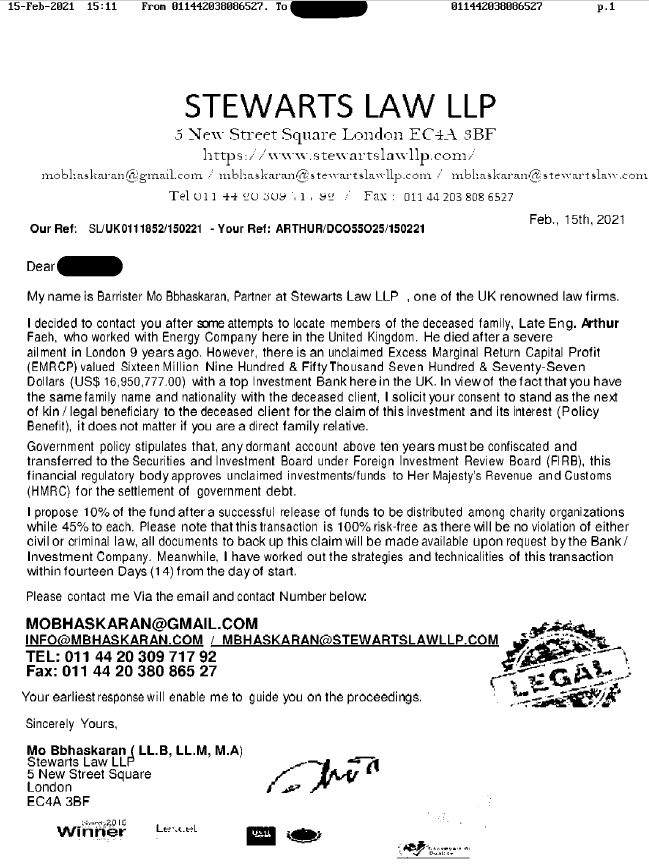
- Fax misusing the address of Stewarts Law LLP
- Emails misusing the name “Stewarts Law LLP”
- A copy of our website but in the name of “Herbert Smith Freehold”
An example of a fraudulent fax is below:
An example of an email is below: