Spinal cord injury recovery is a deeply personal journey, shaped by individual circumstances, support networks and access to the right resources. For those newly injured, understanding how others have adapted to daily life, found support and regained independence can provide valuable perspective.
In this Q&A, we speak with our former client Mike Nixon, a farmer living in the countryside who recently completed the London Marathon for the second time, raising charitable funds for the Spinal Injuries Association (SIA). Mike discusses the first few months after his spinal cord injury, the challenges of adjustment, returning to activities he enjoys and the importance of community and ongoing support.
Can you tell us about your experience of sustaining a spinal cord injury and the early days of your recovery?
I was injured in October 2019 when I fell through a roof while working on a farm. I stayed conscious throughout, so I remember everything. My friend was with me, and I told him straight away that I couldn’t feel my legs and I was in a lot of pain. I immediately worried for myself and my family; I am married with a now-teenage son.
I was transferred to a local general hospital, which took the decision not to operate but to restrict me to bed rest to stabilise my spine, allow the swelling to reduce and prevent further injury. This meant that for the next three months, I basically lay in bed, which personally felt like I was without any rehab or progress. After further assessment, I was eventually transferred to the National Spinal Injuries Centre at Stoke Mandeville Hospital for specialist spinal rehabilitation on 27 December 2019. Another three months later, I was able to go home, but that was mainly due to the Covid-19 pandemic having taken hold.
What rehabilitation and specialist support helped you adjust to life after your spinal cord injury?
My admission and rehabilitation at Stoke Mandeville were great, but coming out of there was particularly tough because of Covid and the country going into lockdown.
I had already met Stewarts before this time to start a compensation claim due to my workplace accident. Stewarts had introduced me to a specialist private physiotherapist, and we had sessions via Zoom, meaning I was able to keep up my progress. When it became possible to meet up, I then started in-person sessions. The clinical team worked me hard, and I made excellent progress. They had equipment such as an exoskeletons and other specialist equipment, which I was able to try out and use in clinics. I also received funding to make adaptations to my family home to help make things more accessible.
What does day-to-day life look like for you now, living with a spinal cord injury?
These days, I am back to living an active, outdoor life with my wife and son in a newly adapted home in the country. On a typical day, I get up early and try to get to the gym for an hour. Then I get into my standing frame, a specialist piece of kit I have at home to use daily. This is crucial to support me in an upright, weight-bearing position and helps improve circulation, bone density and muscle flexibility.
After that, I get stuck into farm life: checking on and feeding the sheep, walking the dog, seeing to the chickens and collecting the eggs, as well as other farming chores.
Twice a week, I help my friend out on his farm. Once a week I go to wheelchair rugby training for my local team, Northampton Saints, and play matches at the weekends.
I want to raise awareness and understanding about different disabilities and spinal cord injuries, so I also give talks at local schools and scouting groups. It can be daunting talking to a room full of people about such a personal topic, but I think it is so important to raise awareness.
What were some of the biggest challenges you faced in adapting to life after your injury, and how did you begin to overcome them?
At our home, we have made everything as accessible as possible, but outside of home, there are some things I still cannot do. I live in a rural setting, and there are old buildings or uneven ground. In the village, I often cannot get into shops in my wheelchair due to reduced access, so there is still a long way to go to improve full accessibility.
However, I am comfortable asking people for help, and people are always happy to provide it. I am comfortable explaining to someone how they can help and what I need. Every now and then, you get someone who rushes in without asking, but I find communication is always the best way. Most people are brilliant and just want to support where they can
Have you been able to return to, or rediscover, activities you enjoy and what has helped you do that?
When I first met Clare Salmon from Stewarts, I was clear that I wanted to get back to farming. Clare was able to help, knowing that was the goal, by connecting me with a specialist spinal injury case manager to help coordinate the right therapy and equipment to make sure I had the right kit to help achieve my goals.
I still do a lot of clay pigeon shooting; I have just had to adapt how I sit in my chair to counteract my lack of core strength. Before my injury, I used to play a lot of rugby with the local farmers’ team, and now I play wheelchair rugby for Northampton Saints. That has opened up a new community for me, as well as getting me more physically active and back to a sport I enjoyed before.
I have always been someone who has to remain active, and that is such an important focus for me. That’s why I have been keen to share my life on social media, showing a different side to spinal cord injury, rather than the preconceptions people may have around limitations.
Were there particular tools, equipment or adaptations that made a meaningful difference to your independence or quality of life?
As mentioned, my home environment has been made accessible, which helps massively. Having a gym and specialist equipment, such as a standing frame, also makes rehab and daily exercises much easier.
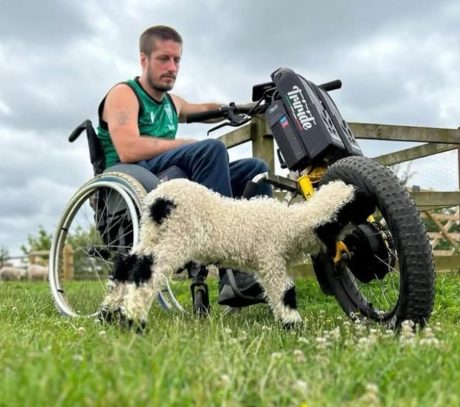
Without a doubt, the most useful piece of kit I have obtained is the RGK FrontWheel for my wheelchair, an all-terrain add-on that lets me travel over grass, gravel or cobbles by lifting the front smaller wheel off the ground. It’s not cheap, but Stewarts and the compensation funds helped make that purchase possible. It makes my day-to-day life so much easier and ensures I can still access the countryside, which is so important to me.
How important has peer support or connecting with others with spinal cord injuries been in your journey?
When I came out of hospital, I didn’t have much peer support because of the Covid-19 lockdowns, and that would have been great to have had. I now visit newly injured patients to ensure they are getting better individual peer support than I did, as I think it is such an important additional role.
I stayed in touch with my old physiotherapists, and they sometimes put me in touch with newly injured people, particularly if they were outdoors and active people.
I hope talking to me helps them, but it definitely helps me. I enjoy speaking to others and trying to pass on my knowledge and experience about living with spinal cord injury.
What advice would you give to someone who has recently sustained a spinal cord injury and may be feeling overwhelmed or uncertain about the future?
The one piece of advice I would give is to keep a strong mindset. That will get you through 90-95% of things. Having that positive mindset and keeping good people around you will definitely help keep you going.
You can see more about Mike’s daily life and the challenges of farming in a wheelchair via his Instagram account @MikeWheelchairFarming.
Clare Salmon, Mike’s lawyer and a Personal Injury partner at Stewarts, comments:
“Mike is the embodiment of living a full life with spinal cord injury and staying true to his life goals. It is a testament to his grit of character and the support he receives from his family, friends and the farming and rugby communities, as well as the specialist spinal rehabilitation he received, even during the Covid pandemic.
“Mike was and remains very determined to push his abilities through exercise, activity and continuing his love of farming and outdoor activities. His story shows the importance of community and communication in moving forward.
“Mike’s Instagram account is an authentic reflection of the full range of emotions and challenges someone with spinal cord injury may face, as well as positive opportunities. Mike never attempts to sugarcoat the difficult days. Instead, by his honest and open posts, he can hopefully provide inspiration and hope to others and, above all, to start conversations about inclusion and acceptance.”
Spinal Cord Injury Awareness Day
This year’s Spinal Cord Injury (SCI) Awareness Day highlights the importance of having a coordinated SCI strategy and ensuring that vital services for SCI patients are not fragmented further. The SIA and other charities are seeking to raise attention to the provision of SCI services and NHS England’s intention to transfer commission from national to local Integrated Care Board level in April 2027.
The Spinal Injuries Association reports that in 2024, the number of people sustaining and living with injuries was far higher than previously thought:
- 4,400 people are injured or diagnosed with a spinal cord injury (SCI) every year, not 2,500 as previously thought.
- The total size of the UK SCI population is now believed to exceed 105,000, not 50,000 as previously estimated.
- This means that approximately every two hours someone sustains a SCI (that’s 12 people a day).
In 2025, these stats have been updated:
- 4,700 people were injured or diagnosed with a spinal cord injury every year. This is an increase of 300 additional cases from last year’s figure.
- The total size of the UK SCI population remains above 105,000.
How can we help with your claim?
Stewarts’ Personal Injury specialists have extensive experience supporting clients who have sustained spinal cord injuries and been injured in the workplace. If you’d like to understand your prospects of making a successful claim, get in touch with us today and speak to our expert team.