On this 2026 National Burn Awareness Day, this article highlights the risks associated with lithium-ion batteries. National Burn Awareness Day is an annual campaign led by the Children’s Burns Trust and the British Burn Association to raise awareness of how to prevent burn injuries and improve knowledge of correct first aid.
Lithium-ion batteries have enabled the rapid growth of e-bikes and e-scooters, but a small number of defective, damaged, or incompatible products can fail with devastating consequences.
Public awareness is increasing as fire and rescue services, the government, safety bodies, and the media warn that these incidents can develop with exceptional speed, produce intense heat and toxic smoke, and block the only escape route from a home.
This article explains the current safety message, the seriousness of potential injuries, and the legal options available to someone harmed by a battery fire.
Why e-bike battery fires are a growing concern
Most e-bikes use rechargeable lithium-ion batteries. These store a large amount of energy in a compact space. If a cell is defective, physically damaged, overheated, overcharged, or used with an unsuitable charger, it can enter ‘thermal runaway’: a self-sustaining reaction in which heat and pressure rise rapidly and can spread from cell to cell.
The warning from the authorities is stark. A BBC investigation reported 18 deaths associated with battery fires between 2019 and 2025. London fire services recorded 793 e-bike and e-scooter fires in the same period. Campaigns by the government (“Buy Safe, Be Safe”), fire services (“Fast, Fierce, Fatal”) and the British Safety Council reflect concern about unsafe products, conversion kits, and chargers being bought through online marketplaces or altered after purchase.
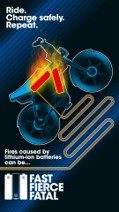
West Midlands Fire Service
Risk does not arise from every e-bike or lithium-ion battery. Correctly manufactured and properly used products are generally safe. The focus is on avoiding poor-quality, counterfeit, incompatible, modified, or damaged equipment and on charging and storing batteries in a way that preserves an escape route.
Practical guidance: buy safe, charge safe and know the warning signs
Government and fire-service guidance emphasises three stages: buying, charging, and responding to warning signs.
- Buy an e-bike, battery, charger or conversion kit from a reputable seller. Check that the components are intended to work together and that the seller provides clear product information, instructions, and a route for recall or redress.
- Use only the charger supplied or expressly approved for the battery. A plug fitting the socket does not mean the electrical characteristics are compatible.
- Do not modify the battery, charger, or electrical system. Avoid second-hand or visibly damaged batteries unless a competent professional has assessed them.
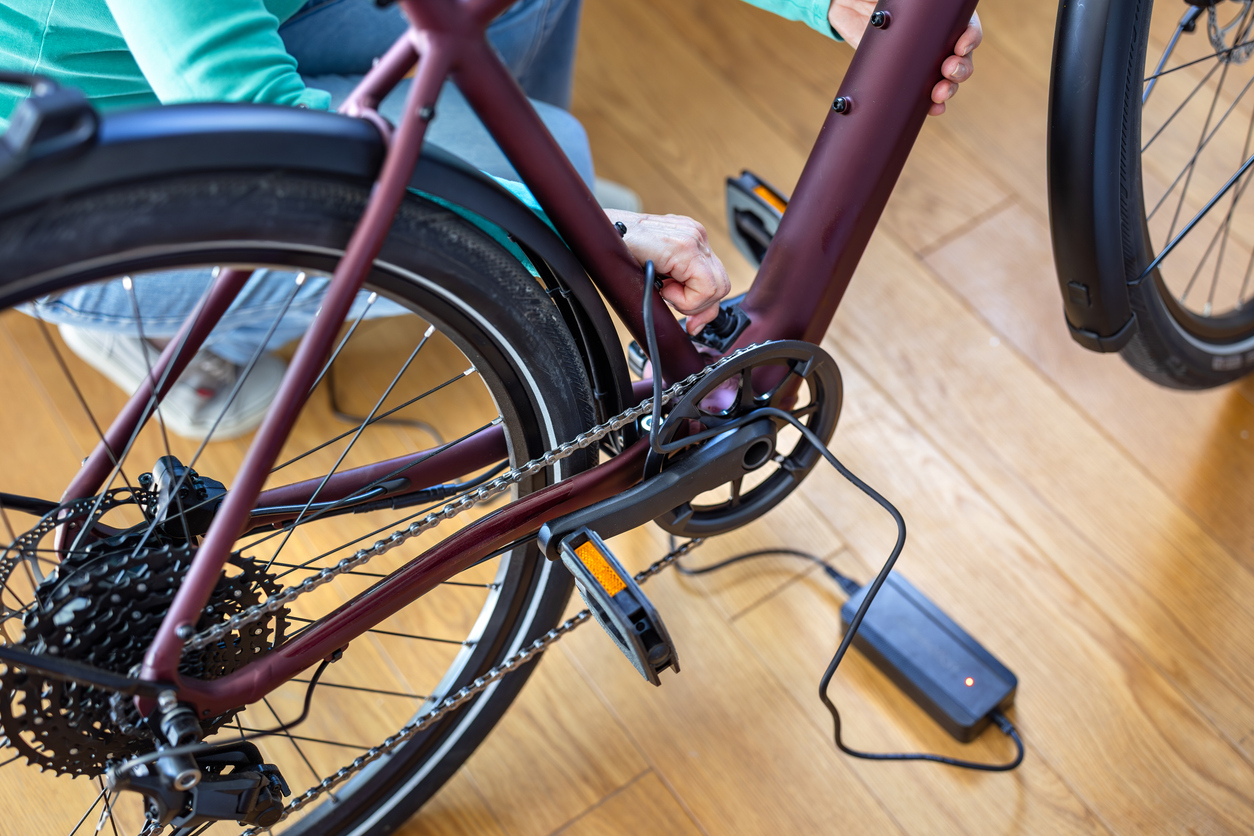
- Charge on a hard, stable surface, away from combustible materials. Do not cover the battery or charger and do not leave charging unattended or continue charging while asleep.
- Keep e-bikes and batteries away from hallways, stairs, and exits. Never allow charging equipment to compromise the household’s escape route.
- Stop using the battery if it becomes unusually hot, swells, leaks, changes shape or colour, makes hissing or cracking sounds, gives off an unusual smell, performs erratically, or takes much longer than expected to charge.
- Ensure smoke alarms are working and everyone in the property knows how to get out. Do not re-enter or attempt to tackle a rapidly developing lithium-ion battery fire.
Why the injuries can be so serious
A battery failure may involve fire, explosion, projectiles, and a sudden release of hot and toxic gases. People may have little time to react, especially where a fire starts during charging at night or in a confined entrance hall.
Published clinical literature describes severe burns associated with lithium-ion battery fires and explosions. Injuries may include deep thermal burns requiring repeated surgery, skin grafting and prolonged rehabilitation, inhalation injury and respiratory complications, eye and facial injuries, blast and impact trauma, and secondary injuries sustained while escaping, including fractures or head injury.
The consequences can continue long after the initial emergency. A seriously injured person may experience scarring, altered sensation, restricted movement, chronic pain, fatigue, and psychological injury. They may need reconstructive treatment, specialist therapy, care, adapted accommodation, or assistance returning to education or work. In fatal cases, the bereaved family may face both profound personal loss and a loss of financial dependency.
What is the legal position if you are injured?
A person injured in England and Wales may have a civil claim if the fire was caused by a defective product or by someone else’s failure to take reasonable care. The correct route depends on the evidence and may involve one or more of the following:
- Product liability: a producer, importer or, in some circumstances, supplier may be liable for damage caused by a defective product. A claim under the Consumer Protection Act 1987 does not require proof of negligence, but the claimant must establish that the product was defective and that the defect caused the injury or damage. Liability may turn on who sold, imported, branded or placed the product on the market.
- Contractual liability: the Sale of Goods Act 1979 implies terms into certain contracts that goods supplied will conform to their description, be of satisfactory quality, and be fit for purpose. If you establish a breach of contract, you can claim damages, including compensation for any loss or harm caused by the goods.
Did you know? Where goods valued at between £100 and £30,000 are purchased using a credit card, section 75 of the Consumer Credit Act enables a person to seek compensation directly from their credit card company, rather than the supplier, if there is a breach of contract or misrepresentation.
- Negligence: to establish a claim in negligence against a third party, a claimant who has suffered injury or loss must prove:
- that the third party owed them a duty of care,
- that the third party breached that duty, and
- that the breach of duty caused the injury or loss.
Third parties might include a landlord, occupier, or other party where unsafe charging arrangements, inadequate precautions or a known hazard contributed to the incident (occupiers’ liability). It could include an employer where an unsafe battery, charging practice or system of work exposed an employee or another person to foreseeable risk (employers’ liability).
Compensation is intended, so far as money can do so, to put the injured person in the position they would have been in but for the incident. It may include damages for pain and suffering, treatment and rehabilitation, loss of earnings, care and assistance, accommodation needs, equipment, and other past or future losses. Fatal claims may include bereavement-related and dependency losses where the statutory requirements are met.
Time limits apply. A personal injury claim usually needs to be issued within three years of the injury, although different rules and exceptions can apply, including for children and people who lack capacity. Defective product claims can also be subject to a separate long-stop period which is 10 years from when the product was first supplied. Claims under contract usually have a six-year limitation period. Anyone affected should obtain specialist advice promptly rather than assume that a longer limitation period applies.
What to do after a battery fire
Once everyone is safe and the emergency services have dealt with the incident, preserving evidence can be crucial. If possible, keep purchase confirmations, product listings, manuals, packaging, and correspondence with the seller. Record the make, model, and serial numbers of the e-bike, battery and charger. Preserve photographs or video of the scene and note any earlier warning signs, repairs, or modifications.
Do not handle, dismantle or dispose of the battery or charger without advice: damaged lithium-ion equipment can remain hazardous, and investigators or experts may need to inspect it. Ask the fire and rescue service, police, landlord or insurer for incident references and reports, and retain medical records and details of financial losses. Report suspected unsafe products through the appropriate product-safety channels.
Early legal advice can help identify the responsible businesses, secure physical and digital evidence, coordinate expert investigation, and arrange rehabilitation. It can also protect the injured person’s position while insurers and other parties investigate.
How Stewarts can help
Stewarts’ specialist injury lawyers act for people who have sustained life-changing burns, blast injuries, brain and orthopaedic injuries, as well as bereaved families. The firm’s combination of serious injury, product liability, and international disputes expertise is particularly relevant where an e-bike battery fire involves a complex supply chain, an overseas manufacturer, an online marketplace, multiple insurers, or disputed technical evidence.
A specialist team can investigate the cause of the fire with appropriately qualified experts, identify potential defendants, assess immediate and long-term needs, and pursue funding for rehabilitation, care, treatment, accommodation, and financial loss. Each case turns on its own facts, and early advice is important.
If you or a family member has been seriously injured in an e-bike battery fire, contact Stewarts to discuss the circumstances and the available legal options.
This article provides general information for England and Wales and does not constitute legal advice.
Further reading and safety guidance
- BBC News: 18 deaths from battery fires show hidden danger of the UK’s e-bike boom
- BBC News: What can I do to prevent e-bike and e-scooter battery fires?
- British Safety Council: Battery Breakdown e-bike fire safety campaign
- GOV.UK: Only purchase safe and legal e-bikes
- West Midlands Fire Service: “Fast. Fierce. Fatal.”
- GOV.UK: Buy Safe, Be Safe
- PubMed: Severe burns related to lithium-ion battery fires and explosions