The London Court of International Arbitration (LCIA) has released its Annual Casework Report for 2025 (the Report). Sherina Petit and James Coen consider the trends and themes revealed by the analysis.
The report covers the calendar year 2025, during which the LCIA received 365 referrals (320 of those being arbitrations under the LCIA Arbitration Rules).
It analyses the LCIA’s caseload, the parties involved (and their industry sectors), and seats and governing laws. It also provides data on emergency procedures, Early Determination, consolidation, interim relief, and on arbitrator appointments and diversity. Overall, 33% of LCIA claims and counterclaims in the period were quantified above $10m. In 2025, parties came from 103 jurisdictions, and arbitrations took place in 21 arbitral seats across 16 jurisdictions. Reflecting the LCIA’s international reach plus the attractiveness of England (and London in particular) as a seat for international arbitration mandates, 96% of the arbitrations involved at least one non-UK party (and 77% of cases involved no UK parties at all). Domestic arbitrations (those with only UK parties) made up a small part of the LCIA caseload (just 4%), and that slice of the pie has remained at 4 or 5% since 2022, when the LCIA started reporting that data.
These are the headline facts, but digging a little deeper reveals some interesting comparative data.
The caseload has remained stable over several years
The 320 arbitral references in 2025 are a slight increase on the 2024 numbers (318). This is significantly less than the pandemic spike of 407 in 2020, but over recent years it appears the referral number is stabilising, albeit at a higher level when compared with the data since 2016.
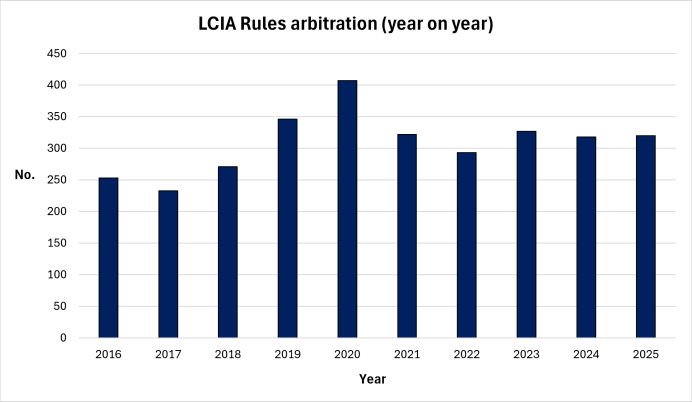
It will be interesting to see if and how the current numbers change in the years to come, particularly given the intensification of geopolitical uncertainty, and the rise of new economic sectors and technologies that will lead to new types of disputes. Competition from other arbitration centres may also play a part, as may the possible effects of AI on the processes and procedures of arbitration.
The sector mix appears to be changing
Transport and commodities remain the largest category for LCIA disputes in 2025, accounting for 25% of matters. However, that has fallen from 29% in 2024, 36% in 2023 and 37% in 2022. At the same time, disputes in two other sector areas have increased: energy and resources disputes have risen to 14% (from 10%), and professional services disputes have more than doubled to 11% (from 5%). Meanwhile, construction and infrastructure disputes have reduced to 4% (from 8% in 2024). This data must be treated with care, and it is worth noting that transport and commodities, energy and resources, and banking and finance comprise 56% of the caseload in 2025, as they did in 2024. So, the balance of these types of disputes may be changing (and it will be interesting to monitor this change in future), but the total share has not since the LCIA’s previous report.
The types of contracts giving rise to LCIA disputes might be changing
Contracts for sales of goods remain the largest contract type giving rise to LCIA arbitration, at 30%. But that has fallen since 2024 (when it was 35%). Meanwhile, arbitration under services agreements has increased markedly, from 18% to 26%. Loan and other facility agreements made up 13% of agreement types in 2025 arbitrations, perhaps reflecting, imperfectly, the 17% of cases from the banking and finance sector.
It is difficult to draw firm conclusions here, but perhaps these changes indicate that, in 2025 at least, the LCIA’s caseload became less dominated by the immediate consequences of disrupted commodities markets. Instead, there has been an increase in disputes arising from a wider range of continuing commercial relationships under longer-term contracts. If that is right, will the global impact of the ongoing crisis in the Straits of Hormuz change the commodities profile for LCIA arbitration in the years to come? Perhaps next year’s data will give us some insight into the direction of travel.
Early Determination applications are being made much more often
Article 22.1(viii) of the LCIA Rules 2020 (the Rules) allows parties to seek Early Determination of claims and counterclaims that are inadmissible or manifestly without merit, and this provision came into effect following the 2020 update. Since 2024, the number of such applications has more than doubled, and the trend since 2021 (when the LCIA began to measure the data) seems to show that parties are becoming much more willing to use this tool:
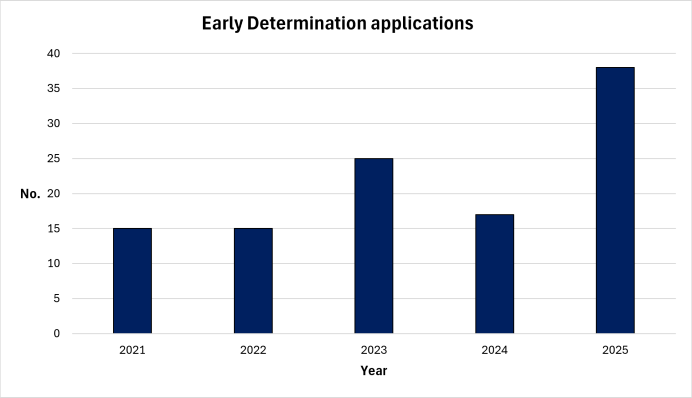
Not that these applications always succeed: 10 were granted in 2025 (33% by the reporting cut-off, compared with 11% in 2024), 20 rejected, seven withdrawn or superseded, and one remained pending. In any case, where applicable, it appears that parties have felt empowered to use this express tool without waiting for section 39A of the Arbitration Act 1996 (the Act) to come into effect. That section, which grants English tribunals the express statutory power to determine claims and defences summarily, came into effect partway through the reporting period, on 1 August 2025. In future years, with any LCIA tribunal’s power made express under the Rules and an English LCIA tribunal’s power having a statutory footing, Early Determination applications will likely become more common.
The LCIA continues to be an international institution
The headline data, as set out in the introduction, is striking. UK parties remain the largest single group in LCIA arbitration, but not overwhelmingly so (at 15.1%). The USA comes second (7.3%), on a par with the UAE (7%), while Switzerland, Kenya, and Italy follow (5.6%, 4.1%, and 2.7%, respectively).
By contrast, the regional data tells an interesting story. The number of parties from the Middle East and North Africa increased to 14.9% (from 10.1% in 2024). Much of that movement came from the UAE, whose share rose from 4.2% to 7%. Asia Pacific fell from 10.1% to 8.2%, while the share of parties from Russia, Belarus, Central Asia, and the Caucasus declined from 3.9% to 2.4% (perhaps not surprising given the sanctions landscape).
There is also growth: the proportion of Indian parties has more than doubled since 2024, from 1.2% to 2.5%, and US participation has also increased to 7.3% (from 6.4%). Will that growth continue in the years ahead?
London seats and English law continue to dominate
London as a seat for LCIA arbitration remains extremely popular: 87% of 2025 arbitrations were London-seated (compared to 88% in 2024). As does LCIA arbitration as a forum for English law disputes: 79% of 2025 arbitrations arose from English law contracts (78% in 2024), and since 2019 that percentage has not dipped below 76% (in 2021). The uptick in English law disputes observed between 2021 (76%) and 2022 (85%) (perhaps reflecting some kind of Covid-19 impact) seems to have settled down.
All this supports the common view that LCIA arbitration and English law disputes go together naturally. International parties choose English law for its certainty, finality, and respect for the commercial bargains parties make. The LCIA is a good fit for parties with English law disputes that want to resolve them through arbitration rather than the English courts. Where London is a seat, parties may have in mind the English courts’ reputation for fairness and their pro-arbitration stance (enshrined in section 1 of the Act). In exercising their supervisory role, the courts have made that stance clear in a wide range of arbitration-related English judgments. Fair outcomes with finality seem to remain an important part of the appeal of London-seated LCIA arbitration.
London is not the only seat, as the Report shows. The Dubai International Financial Centre (DIFC) comes second (with 10 arbitrations), followed by Nairobi, Paris, and Port Louis in Mauritius, each with three. Overall, 39 arbitrations were seated outside London, 13 in the UAE and eight in sub-Saharan Africa. These numbers seem fairly modest, but might they increase in future years? Parties may increasingly want to use the LCIA’s procedures for non-English law disputes without the supervisory jurisdiction of the English courts or the Act’s mandatory procedural provisions. In 2025, the laws of six African jurisdictions governed 24 arbitrations. Perhaps that indicates that parties want their disputes determined and supervised under the same local substantive law. If that is right, parties will need to be careful to make their seat choices express in their arbitration agreements, to comply with Article 16.4 of the Rules (a default now enshrined in English arbitration law via section 6A of the Act (effective from 1 August 2025)).
More women and non-UK persons are being appointed as arbitrators
Thirty-eight per cent of appointments in 2025 were of women, the highest proportion since the LCIA started reporting the data. Just above three-quarters of three-member tribunals included at least one woman, and 41% of sole arbitrators were women.
This is encouraging, and the LCIA deserves praise for its own selections. Where the LCIA Court appointed an arbitrator, it appointed women in 49% of cases (up from 45% in 2024). In this respect, the LCIA is better than the ICC, for example (which in 2025 saw appointments or confirmations of female arbitrators in 29.6% of cases). But parties still need to be braver. Only 27% of party selections were women (up from 21% in 2024). The gap between the LCIA’s laudable appointment record and that of parties seems stark.
There is better news on non-UK arbitrator appointments. Of 403 appointments, 52% (211) were of nationalities other than British. That makes 2025 the first year in which non-UK arbitrators received a majority of appointments. Perhaps this development reflects parties’ increasing expectation that their arbitrators need a deep understanding of their local markets and customs to enhance a background or qualification in the applicable law, English or otherwise.
Composite requests, consolidation and emergency and interim measures
The Report indicates that the LCIA remains able to handle the most complex interrelated mandates, and it appears that such cases are now simply a feature of LCIA arbitration:
- In 2025, 32 composite requests commenced 76 arbitrations, representing 24% of the total.
- There were 44 consolidation applications involving 95 cases, of which 82% were granted (25 of the 32 composite requests were ultimately consolidated).
- Fifteen applications were made under Article 9A of the Rules (for expedited formation of the tribunal), with five succeeding. Three emergency arbitrator applications (Article 9B) succeeded, of the seven made in 2025. While these numbers are not particularly high (the ICC processed 30 emergency arbitrator applications in 2025), the LCIA’s decision-making appears to be speedy. The Article 9A applications were determined in a median of five calendar days (with formation on success taking a further median of five calendar days), while the Article 9B applications were determined in a median of two calendar days.
- Security for costs applications were the most common interim measures sought by parties (41 out of 66 applications). Of those, half were allowed in full or partially. LCIA tribunals have wide discretion in determining such applications, but because the awards are not published, it is difficult to assess how that discretion is exercised. Most likely, it is exercised in a case-specific manner. With the Rules currently under consultation, and with the publication of anonymised awards identified as one of the themes of interest in that process, it will be interesting to see if the LCIA decides to allow anonymised publication of security for costs awards, to allow the development of a body of LCIA-specific case law in the years to come. This could be a double-edged sword for parties and practitioners if it narrows the current discretion, given that, in the right circumstances, that discretion can give parties a strategic advantage in both making and resisting such applications.
Conclusion
As highlighted above, the Report is full of interesting data from which various insights can be drawn. That includes data on the LCIA’s own administration (a new feature). For example, 96% of the Secretariat’s first letters to parties were sent within three business days, and the median time taken by the Secretariat and LCIA Court to process and communicate arbitrator selection, proposed rates, and the statement of independence to proposed candidates was 13 business days (the average was 20 business days). Administrative efficiency is often touted as a selling point of institutional arbitration, and by publishing this data for the first time, the LCIA is beginning to evidence that efficiency for future years.
Perhaps more importantly for parties, there is data on efficiency of cost and duration. Between 1 January 2017 and 12 May 2024 (based on cases that reached a final award), median LCIA arbitration costs were US$117,653 and median duration was 20 months. In 2025, the ICC reported a median duration of 23 months. While these two data points do not match precisely, they do seem to indicate relative parity in duration of arbitration across institutions, a dispute resolution process that is probably faster than complex, high-value litigation before national courts (albeit direct data comparisons are difficult where courts collect data only on trial duration).
As noted above, the LCIA’s consultation on the Rules is ongoing, with revisions due come into effect in 2027. Those changes will impact casework reporting in future years, perhaps adding new areas for analysis as well as data on parties’ increasing or decreasing use of the various tools available in LCIA arbitration. All told, the Report will remain a valuable resource on LCIA arbitration for practitioners and their clients.
For further information, please contact the authors. Stewarts’ analysis of the ICC’s 2025 statistics can be found here.