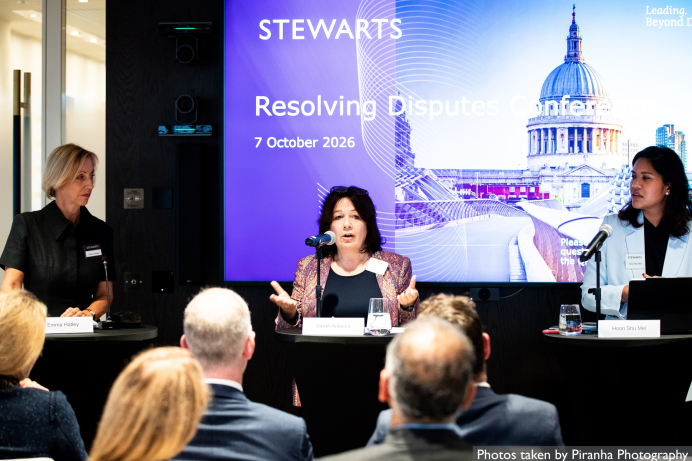
Resolving family disputes is rarely straightforward, but selecting the right process at the right time can make a significant difference to both the outcome and the experience of those involved. At the Resolving Disputes Conference, Emma Hatley chaired a panel featuring Suzanne Todd, Sarah Anticoni, and Shu Mei Hoon, who explored the evolving role of mediation, collaborative law, and other consensual approaches in helping families achieve lasting settlements.
A central theme emerging from the discussion was that mediation should not be regarded as a last resort once litigation has failed. Rather, it should be considered at the outset as a genuine and highly effective route to settlement.
The panel challenged the common assumption that mediation is suitable only for straightforward cases. In reality, suitability depends less on the complexity of the issues and more on the parties’ ability to engage constructively in the process. Effective screening by the mediator is therefore critical, particularly where there are safeguarding concerns.

Delay, cost, and confidentiality continue to drive interest in mediation. Equally attractive, however, is the flexibility it offers. Unlike court proceedings, mediation can be adapted to the particular needs of the family, provided there is a skilled mediator able to guide discussions, manage dynamics, and maintain momentum towards agreement.
The panel also emphasised the important role solicitors play in creating the conditions for settlement. From the earliest stages of a matter, lawyers can help clients understand the range of likely outcomes, build confidence in the process, and preserve goodwill where possible. Conversely, unnecessarily adversarial correspondence can quickly undermine opportunities for constructive dialogue and meaningful negotiation.
Any agreement reached through mediation must also be both practical and enforceable. This is especially important where there are international elements, overseas assets, proceedings in multiple jurisdictions, or third-party stakeholders such as trustees. Parties need a clear understanding of the asset landscape and any potential enforcement or jurisdictional challenges that may arise in the future.
The growing involvement of solicitors within mediation was another theme explored by the panel. While legal support can provide reassurance and confidence for clients, there is also a risk that participation may become more positional if lawyers feel compelled to advocate too strongly. The panel suggested that lawyer-assisted mediation is likely to continue gaining traction as a balanced and effective model, alongside other established approaches such as shuttle mediation.
The discussion highlighted that a mediator’s role extends well beyond facilitating communication. As an independent and neutral third party, a mediator often gains insight into concerns, priorities, and interests that may never be fully articulated in a court setting. One developing area is hybrid mediation, in which the mediator is authorised to “keep confidences” regarding the parties’ respective negotiating positions. This can be particularly effective in overcoming deadlock and assisting parties in identifying practical compromises.


The panel also considered collaborative law, which continues to evolve despite a slower rate of adoption than some practitioners may have hoped. Success depends upon involving appropriately trained professionals and introducing the option early, before positions become entrenched. Feedback from practitioners suggested that collaborative law continues to flourish in certain geographical areas, indicating that trust and confidence between professionals may be an important factor in its success.
Practical considerations remain fundamental. Material disclosure is essential to enable informed decision-making, although absolute perfection is rarely required. Equally important is distinguishing between parties genuinely seeking settlement and those who may be using mediation principally as a delaying tactic. Careful case management, combined with close collaboration between solicitors and mediators, can significantly enhance the prospects of success. As the panel observed, practitioners should devote as much effort to preparing people for agreement as they do to preparing cases for trial.
Looking ahead, the panel considered the role of technology, including artificial intelligence. While AI may streamline administrative tasks and assist with document review, family law remains highly discretionary and fact-sensitive. Professional judgement therefore remains indispensable, and clients should approach AI-generated legal analysis with caution and seek legal advice before relying upon it.
Ultimately, the discussion reinforced a simple but important principle: agreement is most likely when parties are given the right support, information, and environment in which to negotiate. Mediation and other consensual dispute resolution processes are not alternatives to justice. Increasingly, they are becoming central to its delivery.