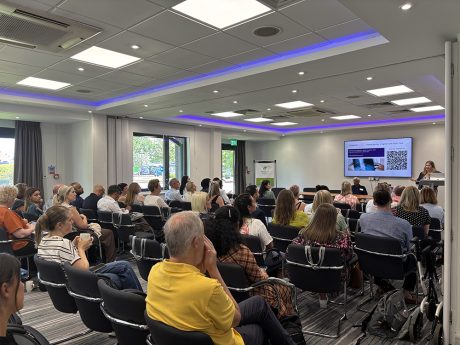
On 22 June 2026, Stewarts’ conference dedicated to spinal cord injury (SCI) took place in Aylesbury, home of Stoke Mandeville Hospital and the Paralympic Games, where Sir Ludwig Guttmann pioneered an approach to SCI rehabilitation that continues to influence practice today. The theme of this year’s SCI conference was “Raising the Bar in SCI Care – Clinical excellence, legal insights and improving patient outcomes” with the event also fundraising for the Back Up Trust.
Dr Shyam Swarna (Consultant in Spinal Cord Injury at the National Spinal Injuries Centre) and Clare Salmon (Partner in the Personal Injury department at Stewarts) opened the conference, and over 70 attendees were treated to a series of talks from experts, including:
- Mr Frank Chege (Patient Liaison Nurse at the London Air Ambulance)
- Dr Ahmad Saif (Consultant in Rehabilitation Medicine/Clinical Director for SE Neurosciences and Trauma Strategic Network/Thames Valley Trauma Network Rehabilitation Lead/RM Training Programme Director)
- Ms Zoe Jeffery (Training and Educational Lead, Spinal Cord Injury Rehabilitation Network, North East and Yorkshire)
- Dr Victoria Bancroft (Consultant Clinical Neuropsychologist at King’s College Hospital)
- Dr Liz Pounds-Cornish (Principal Clinical Psychologist at the National Spinal Injuries Centre)
The talks were complemented by presentations from Clare and another Stewarts partner, Nadia Krueger-Young (Medical Negligence).
There were also panel sessions from two former Stewarts clients, who shared their perspectives on their rehabilitation journeys.
Talks from the experts
Frank Chege kickstarted the day with his talk, “Survival vs Recovery”, and spoke passionately about the differences between survival and recovery. He explained the importance of recovery following life-threatening injuries and described how effective rehabilitation offers seriously injured people a second chance in life. He explained how recovery can be long and that it is not always linear. He described how clinicians, patients and families can work together to help with the recovery process, which he cautioned was particularly crucial in light of the challenges the healthcare service is facing in 2026.
Attendees were then treated to a fascinating talk from keynote speaker Dr Ahmad Saif, titled “Building the Bridge to Recovery – early decisions that shape long-term clinical outcome”. Dr Saif explained that an accumulation of multiple early decisions during the acute stage can influence long-term outcomes for SCI patients, which is why timely, specialist SCI input is crucial. He set out the positive outcomes that patients have received when they have early SCI expertise, including reducing the risk of readmission due to complications related to pressure sores. He highlighted the importance of including SCI expertise early in the pathway to give patients the best possible chance of recovery. He concluded his talk by advocating that no patient should have to rely on chance to access specialist SCI help.
Ms Zoe Jeffery then delivered a talk about “Understanding Behaviour in Spinal Cord Injury: Delivering Compassionate and Effective Care”. She described how important it was to listen to patients and to understand the various factors that might contribute to challenging patient interactions. She explained the need to look beyond challenging patient behaviour, which could be related to fear or a response to not being heard.
Dr Victoria Bancroft and Dr Liz Pounds-Cornish kicked off the afternoon with a session on “Supporting Adjustment and Recovery After Spinal Cord Injury: Psychological Input across the pathway”. They explained what adjustment meant and that the absence of a mood disorder does not negate the presence of adjustment difficulties. They advised that adjustment issues are not linear. They advocated for the importance of screening during admission, in particular because sometimes the people struggling the most are the least likely to ask for help.
Legal and client perspectives
Clare Salmon demonstrated how early engagement with specialist lawyers can help clinical teams, removing barriers to rehabilitation, supporting informed decision-making and reducing anxiety for patients and families. She explained the work that the Pro Bono team at Stewarts does for SCI patients, including assisting with deputyships and powers of attorney and helping with debt write-offs.
Nadia Krueger-Young, a medical negligence partner at Stewarts, then delivered an insightful talk on the importance of record-keeping in a clinical setting. She explained that good documentation helps with patient care and safety, as well as reducing the risk of misunderstandings, disputes and legal challenges. She provided examples of previous cases to help clinicians protect themselves and their patients.
These talks were followed by a panel session from two former Stewarts clients, Mike Nixon and Nick Churcher. Clare was joined by Alison Goldney, a medical negligence partner at Stewarts, who outlined Mike and Nick’s cases. Mike and Nick answered questions about their rehabilitation journeys and what they thought could have been done better during their recovery.
Panel discussion
The conference concluded with a lively panel discussion chaired by Dr Alex Rouse (Consultant Physician and Paediatrics Lead at the National Spinal Injuries Centre). In addition to the above expert speakers, the panel also included Andy Masters (Head of Services Strategic Partnerships at Back Up). The panel addressed a range of topics, including the non-financial improvements each of them would implement to enhance the lives of SCI patients in an environment where securing public funds to improve services remains an ongoing challenge.